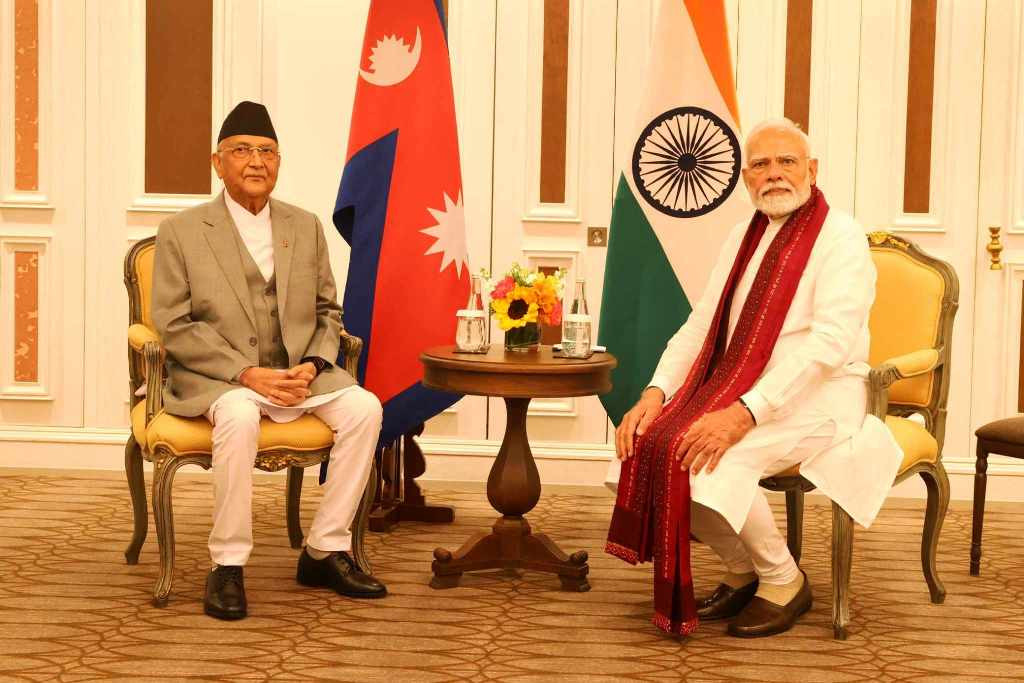
After the rise of Modi in Indian Politics, as a Prime Minister candidate for Bhartiya Janata Party (BJP), the expectation and hope for prosperous and powerful India was all over the country. There was a speculation on how he would engage Hindutva in his foreign policy and serve pre-existing institutionalized Indian policy. As Modi and BJP, had huge pride on Indian sub-continents orientalists’ history and culture, mostly drawn from Hindu traditions.This nature drew an attention in Nepalese society, on how a pro-Hindu leader would rejuvenate the lost glory of regions cultural heritage.
Though this might remain in mind and heart of religious people, it soon turned out how Hindutva remains only as a soft power in Indian foreign policy and Modi soon following on pragmatic footsteps of his predecessors. With the development of his foreign policy in wider context, it is certain that India’s realist approach is utmost priority for Modi despite its(religion) weaponization in internal politics.
In Modi's foreign policy, Hindutva has not played a major role. Modi does not believe that he is a Hindutva hero in the way that critics primarily—though not exclusively—have suggested. The evidence derived from foreign policy behavior is more instructive. Nearly everything about the acquisition of power, its use, and its strategic behavior towards allies and foes is based on precedent and shows a high degree of consistency. It has very little to do with religious beliefs.
Thus, despite its distortions at home, Modi's policies are still defensive realist when it comes to the outside world. India, a rising power with vested interests in the system, lacks the intellectual and emotional will to veer from the well-trod route that Modi has chosen and is currently on.
In a different circumstance, soft touch on Hindutva is evident in his first visit to Kathmandu. His Pashupatinath visit was a highlight on both sides of media and his instant pairing it with Kashi- Bishwanath in Banaras (another ShivaTemple) shades a light on his home audience regarding his sensitivity towards religion beyond the border. It also somewhat helped Nepal to draw religious tourist in the country. In either way, its religious glory that wins, with his soft oratory style.
Not only limited in this, but Modi’s second state visit to Nepal in 2018 was directed towards Janakpur and Mukti Nath. Both Hindu pilgrimage site, latter one in high Himalayan region in Western Nepal. Janaki Temple and Ramayana Circuit was some of his attention in his visit to Janakpur. Again, in 2022, he was in Lumbini alongside Sher Bahadur Deuba (the then Nepal’s Prime Minister). This time it was regarding Buddhist circuit and signify thecommon cultural linkage of Nepal-India regarding Buddhism. (He, along with most of the Hindu, take Buddhism as interconnected part of Hinduism.) This also is an assertion and inclination towards Hindutva. These kinds of acts can have different meaning in domestic politics, including his personal branding. Despite his frequent pilgrimage visit in Nepal, so is not translated in other dimensions of Nepal-India relation rather it is maintenance of realist approach.
Modi’s ‘Neighborhood first’ policy brought a new hope on South Asian countries and expected India to take a lead for higher cooperation in this region. He invited every state leader from South Asia, including Pakistan, in his oathceremony. Likewise, every leader attended the event except Sheikh Hasina (she was busy in other state visit) from South Asia. Within 100 days of his oath, he visited Bhutan, Nepal and Japan. His first visit to Nepal on 3rd and 4thof August 2014 was first time of Indian Prime Minister in 17 years.
Modi’s proactive approach and attention towards small neighbors had optimist impression in Indo-Nepal relation. His oratory style and Hindu inclination soon became a talk of a town in Kathmandu. Media from both sides followed him extensively and detailed attention was given to his words. His Pashupatinath visit followed by speech in Constituent Assembly was a prime example of how good orator he can be even in foreign soil. He started his speech in Nepali and referenced many examples linking the common heritage of Nepal and India. He talked about Buddhism and the great emperor Ashoka. His articulation theme was surrounded on projecting Nepal as a holy land. With that theme he suggested Constituent Assembly members to be of ‘Rishi-man’ while drafting the constitution. His selection of words and reference to Hindu tradition clearly showed his image as proud Hindu leader who takes the religion and culture in high regard.
It would be unfair, to limit his presence in religious terms only, in his speech he expressed how he values his relationship with Nepal unlike his predecessors. He with full of energy and rigor expressed his vision to Nepal andways of cooperation from Indian side. He derived HIT formula, Highway(H), Information Technology(I) and Transmission line(T) from which Nepal can develop itself with Indian Assistance. His speech embarked an era ofoptimism in diplomats and officials of Nepalese side. Despite his generous great figure branding, Nepal has lot of upheaval to face in this relation in coming years.
It was evident that “the difference between Modi and his predecessors is a matter of energy and style, if not other” which could be seen in his speech and public appearance in his Nepal visit.=
The MEA declared a "renewed energy, vigor and planning in India’s engagement with the rest of the world" with the BJP winning power, and their yearly reports have been progressively more confident, forward-thinking, and global in scope. India was portrayed as “a confident, articulate, (and) rising power... no longer content to merely react to international developments,” resolutely reflecting the proactive nature associated with BJP diplomacy. In a similarvein, officials declared that "an India that aspires to a greater global role must necessarily have a larger diplomatic footprint." This assertion is supported by the fact that under Modi, the number of diplomatic missions, visits, and summits has significantly increased, surpassing that of Manmohan Singh during the previous UPA (United Progressive Alliance).
Scholars characterized the new NDA (National Democratic Alliance) as "a much more decisive and confident government, which has injected a new sense of dynamism in Indian foreign policy". Additionally, the NDA was more overt in its goal of elevating India's stature, influence, and authority globally and less ambiguous in its promotion of the country abroad. The BJP's signature pragmatism-that is, its hard-nosed, nationalist diplomacy thatmeant “pragmatism, not principle, and delivery, not doctrine is the marks of Modi’s approach”- was at the center of these arguments. Under Modi, such a style or attitude has become ingrained in the discourse around Indian foreign policy. Such a style is based on strong personal motivation and attention, in Modi's own words “whichever assignment is given to me. I am totally involved in it. I never think about my past, I never think about my future.”
Indian development assistance has been influenced by his more assertive foreign policy position. On the one hand, the Indian government's strategy for providing international, state, and individual aid has remained largely consistent. The prior Indian government did not alter the strategic goals that underpin Indian development assistance or the country's ongoing use of aid as a tool of soft power to improve India's standing overseas. In this visit, Modi focused on Line of Credit rather than grants and loans. He announced a “soft Line of Credit (LOC) of 1 billion US$ for the execution of Infrastructure development and energy projects as identified and prioritized by the government of Nepal.”
Under Modi, India views development assistance as a practical instrument of diplomacy and as something that benefits both parties. Clutched in the language of internationalism and liberalism, realism views of aid as a tool tostrengthen India's power—bilateral, regional, and worldwide—as well as maybe Prime Minister Modi's own, are becoming increasingly prevalent in Indian foreign policy under Modi.
Increasing the amount of LOCs allocated to surrounding nations has had two benefits. Since all LOCs are mandated to source a minimum of 75 percent of their goods and services from India. These policies are endorsed by Modigovernment's India First policy through Neighborhood First and Act East policies in India. Under Modi, Indian foreign assistance has actively shifted towards reprioritizing the area in India's development partnerships andestablishing mutually advantageous bilateral relationships in the region, if one considers all new operational and committed LOCs.
The way that Prime Minister Modi handles Indian development assistance reflects his more assertive and centralized approach to foreign policymaking. While continuing the previous administration’s commitment to increasing Indian foreign assistance commitments and maintaining the strategic imperatives underlying Indian assistance, systemic- and national-level factors in determining foreign aid remained largely unaffected. Prime Minister Modi has directly overseen the growing mercantilization of Indian foreign assistance, but unlike thegovernments of the previous three decades, individual-level considerations have been a major determinant of Indian foreign aid.
The 2014 visit also touched on delicate border issues. The need to resolve Nepal-India boundary issue was acknowledged from both Prime Minister. Boundary Working Group (BWG) was formed to oversee border issues and to direct respective foreign secretaries to resolve the pending issues including Kalapani and Susta region. Another similar was to amend or update some of the treaties between the countries. In Nepal, some treaties areperceived as unfair and outdated which becomes a regular issue in domestic nationalist political agenda. For this also,the issue was directed towards foreign secretaries of both the countries for further discussion. The visit took a step toform Eminent Persons Group Nepal-India Relation (EPG-NIR) for suggestive role on the development of Nepal-India Relation in totality, which was well received at the beginning but could not be fruitful in long-term.
(It is the first part of four series)